🔐 Zero-Knowledge Proofs (ZKPs): The Future of Private and Secure Verification
In the era of digital transformation, privacy and security are more important than ever. Whether it’s verifying your identity, confirming a transaction, or accessing services, proving something without giving away sensitive data is a powerful concept. This is where Zero-Knowledge Proofs (ZKPs) come in — a revolutionary cryptographic method that allows someone to prove they know something without revealing the actual information.
📌 What is a Zero-Knowledge Proof?
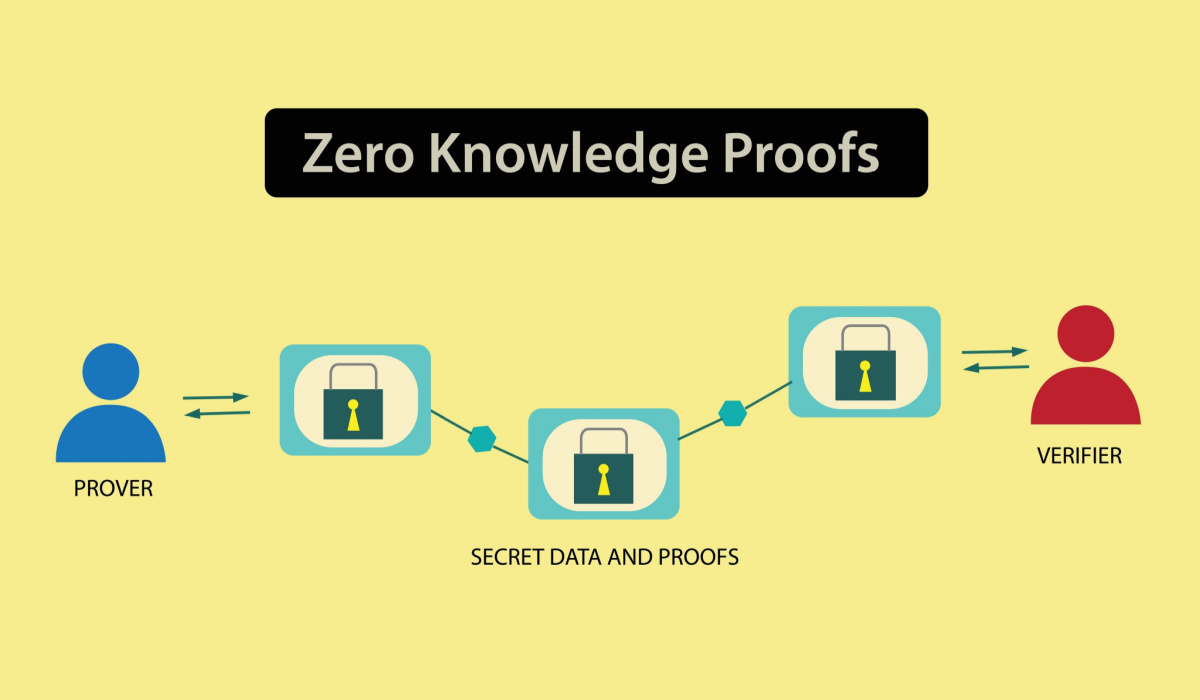
A Zero-Knowledge Proof is a cryptographic protocol that allows one party (the prover) to prove to another party (the verifier) that a certain statement is true, without revealing any other information besides the fact that the statement is indeed true.
In simpler terms:
“I can prove I know the password, without telling you what the password is.”
🧠 The Concept in Plain Terms
Imagine a scenario: Alice wants to prove to Bob that she knows the solution to a puzzle, but she doesn’t want to reveal the actual solution. Using ZKPs, she can convince Bob that she indeed knows the answer, without exposing the solution itself.
This may sound like magic, but it’s based on advanced mathematics and cryptography. The goal is to protect data privacy while maintaining trust.
📚 The Three Properties of ZKPs
For a protocol to be considered a Zero-Knowledge Proof, it must satisfy three properties:
- Completeness
If the statement is true and both prover and verifier follow the protocol honestly, the verifier will be convinced. - Soundness
If the statement is false, no dishonest prover can convince the verifier that it’s true, except with a small probability. - Zero-Knowledge
If the statement is true, the verifier learns nothing other than the fact that the statement is true — no additional knowledge is leaked.
🔎 Real-World Analogy: The Magic Door Puzzle
One famous example used to explain ZKPs is the Ali Baba cave:
- A circular cave has a hidden door that opens with a secret code.
- Peggy (the prover) wants to prove to Victor (the verifier) that she knows the code.
- She enters the cave and randomly chooses one of two paths (left or right).
- Victor waits outside and shouts which path he wants her to come out from.
- If she knows the secret code, she can always open the hidden door and appear from the chosen path.
- After repeating this multiple times, Victor becomes confident that Peggy indeed knows the secret, without ever learning what the secret is.
This is Zero-Knowledge at work.
🏗️ How Zero-Knowledge Proofs Work (Technically)
There are multiple types of Zero-Knowledge Proofs, but they often follow a general structure:
- Commitment – The prover creates a cryptographic commitment to a piece of information or a secret.
- Challenge – The verifier sends a random challenge to the prover.
- Response – The prover responds in a way that only someone with the secret could do.
- Verification – The verifier checks whether the response is valid based on the challenge and commitment.
Repeat this interaction multiple times to eliminate the chance of cheating.
There are two main categories:
- Interactive ZKPs – Requires back-and-forth communication.
- Non-Interactive ZKPs (NIZK) – All proof and verification are done in a single message. Very useful for blockchain and decentralized applications.
🔬 Types of Zero-Knowledge Proofs
🔹 zk-SNARKs (Succinct Non-Interactive Argument of Knowledge)
- Small proof size
- Fast verification
- Widely used in blockchain (e.g., Zcash)
🔹 zk-STARKs (Scalable Transparent Argument of Knowledge)
- No trusted setup required
- Larger proof size, but more scalable and quantum-resistant
🔹 Bulletproofs
- Compact, non-interactive proofs
- Useful in confidential transactions, like those used in the Monero blockchain
🌍 Applications of Zero-Knowledge Proofs
ZKPs are already transforming several industries:
🔐 1. Blockchain & Cryptocurrencies
- Private Transactions: Zcash uses zk-SNARKs to allow shielded, fully private transactions.
- Scalability: zk-Rollups (used on Ethereum Layer 2) bundle many transactions and generate a ZKP to verify all of them in one go.
- Identity Verification: Authenticate users without revealing private information (like date of birth or full ID).
🏦 2. Finance and Banking
- Verify credit scores or balances without exposing full financial history.
- Reduce data leaks and improve KYC/AML compliance without over-collecting user data.
🧑💼 3. Authentication & Identity Management
- Login systems that confirm user credentials without storing passwords or biometric data on servers.
🏥 4. Healthcare
- Verify medical records access rights without exposing actual records.
- Consent management for sensitive medical data.
🛒 5. Supply Chain
- Verify product authenticity or origin without disclosing the full path or sensitive supplier information.
⚙️ ZKPs in Blockchain: zk-Rollups Example
zk-Rollups are a Layer 2 scaling solution that aggregates multiple transactions off-chain, generates a zero-knowledge proof, and submits it to the main blockchain.
Benefits:
- Lower Gas Fees
- Faster Transactions
- Privacy (depending on implementation)
- Security maintained by mainnet (e.g., Ethereum)
Examples of zk-Rollup solutions: zkSync, StarkNet, Polygon zkEVM.
🧱 Challenges of ZKPs
Despite their promise, ZKPs are not without hurdles:
🧮 Complexity
- ZKPs rely on advanced mathematics, which makes development difficult and error-prone.
🐢 Computational Cost
- Generating proofs, especially with zk-SNARKs or zk-STARKs, can be resource-intensive.
🔒 Trusted Setup (for zk-SNARKs)
- Some ZKPs require a “trusted setup,” a secure generation of cryptographic keys. If compromised, the entire system could be insecure.
🚧 Integration Difficulty
- Adopting ZKPs into existing systems (especially in Web2) may require architectural overhauls.
🔮 The Future of Zero-Knowledge Proofs
ZKPs are seen as a cornerstone of Web3 and the decentralized internet. With growing concerns over privacy and data control, ZKPs provide the perfect balance of security, transparency, and discretion.
Upcoming trends:
- More scalable zk-STARK systems
- Privacy-focused DeFi applications
- Cross-chain ZK verification
- Governments exploring ZKPs for digital ID systems
✅ Conclusion
Zero-Knowledge Proofs represent a breakthrough in how we verify truths in the digital world — securely, privately, and efficiently. As we move into an increasingly digital future, ZKPs will play a vital role in protecting personal data, enabling trustless systems, and scaling decentralized networks.
Whether you’re a developer, investor, or privacy-conscious user, understanding ZKPs is essential to grasp the direction of modern cryptography and blockchain technology.